> For the complete documentation index, see [llms.txt](https://guide.tonaly.app/llms.txt). Markdown versions of documentation pages are available by appending `.md` to page URLs; this page is available as [Markdown](https://guide.tonaly.app/settings/musical-preferences/auto-voice-leading.md).
# Auto inversions (voice-leading)
Default setting: ON; Octave: C3
> To find this setting, [**navigate to the "Musical preferences"**](/settings/musical-preferences/untitled.md).
The app will create an automated voice-leading from one chord to the next.
{% hint style="info" %}
This will create **automated inversions**. Explicit inversions for certain chords are not yet possible.
{% endhint %}
**What does voice leading mean?**
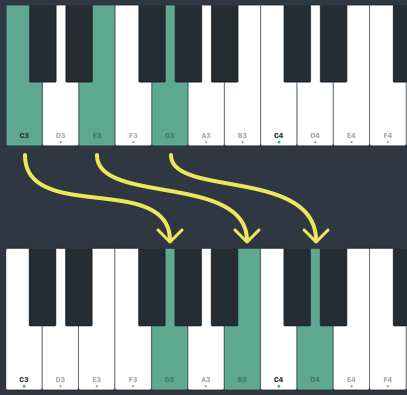
If we go from one chord to another for example from "C major" to "G major" it would look like this:
The distance between the chord tones is quite large. This is why the change will sound kind of odd.
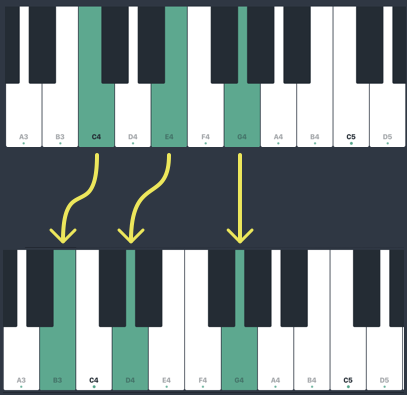
If we have a look at the chord tones, we will see, that the tones of "C major" (C-E-G) and the tones of "G major" (G-B-D) are actually not so far away from each other if we just play some of them an octave lower.
Let's have a look at how this would look like:
The **C** of "C major" becomes the **B** of "G major".
The **E** of "C major" becomes the **D** of "G major".
The **G** of "C major" remains and will be the root of "G major".
In this way, we have a much smoother transition between the chords.
This is called "Voice-leading" or "Inversions".
You can also adjust the **octave of the playback here.**